Your Firm Isn’t Supposed to Scale

Newsletters

Your Firm Isn’t Supposed to Scale
There’s so much pressure these days for founders to scale their firms.
Scale…
Every founder you know is chasing it.
Every VC sermon preaches it.
Every LinkedIn post worships it.
Hire faster.
Productize.
Build the playbook.
Turn the senior craft into a junior-delivered system.
But most of these strategies break the thing that made the firm valuable in the first place.
And for a firm like yours, it’s the wrong target.
carve-left
 
What “Scale” really means is that it’s a volume game.
You scale by serving more clients at a lower marginal cost – which means standardizing the work, pushing delivery down to junior people, and turning senior craft into a documented system a cheaper team can run.
Scale is the pyramid.
More base, same apex.
That model is collapsing at the big firms right now, as AI takes over the work that was done at the base of the pyramid.
But let’s set that aside for a moment…
The even deeper problem is that for a smaller or mid-size boutique professional services firm, the pyramid was never your model.
The senior craft IS your product.
The reason clients pay you – the reason they pay a premium – is that the people who sold the work are the people who know the work and are the people doing/managing it.
Scale, the way the word is meant today, dilutes the exact thing you’re charging for.
carve-left
So scaling a boutique firm tends to break it.
The work gets more generic.
The margins the founder dreamed of never arrive, because the clients who paid for senior judgment notice when they stop getting it.
There’s a different growth model.
It’s the one boutique firms are actually built for.
COMPOUNDING.
Compounding is a depth game.
Instead of adding more clients at lower value, you grow the value of the relationships you already have.
The client who came for one project comes back for three.
The referrer who sent one introduction sends twenty, maybe over a decade.
The ex-client who moved to a bigger company brings you in at that bigger company.
Each relationship is an asset that grows if you tend it.
carve-left
 
Picture two firms over five years.
The scaling firm doubles its headcount, doubles its client count, halves its average engagement value, and works twice as hard for the same money. The founder is exhausted and the brand is more generic than it was.
The compounding firm keeps a tight senior team, grows the average client relationship from one engagement to an ongoing partnership, and gets most of its new work from people it already knows.
Same revenue growth.
A fraction of the effort.
A stronger firm at the end.
carve-left
 
So why does everyone chase scale?
Because it’s the only word the business world teaches today.
Because compounding is invisible on the metrics most firms track.
Because relationships don’t show up on a growth dashboard.
That last one is the real trap.
A firm tracking only new logos and headcount will never see its compounding engine – or know that it is broken.
The value living in your existing relationships, decaying quarter by quarter, sits in nobody’s dashboard.
The dollar size that you are losing because of it is your Revenue Gap.
carve-left
I have built a calculator that walks you through a few quick questions about your firm – your relationships, your engagements, the basics – then gives you the Revenue Gap dollar number at the end.
It takes about 90 seconds.
And it’s free.
Calculate your Revenue Gap here →
carve-left
 
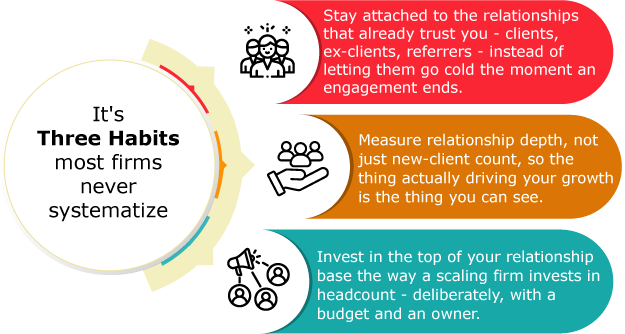
Compounding, in practice, is not complicated.
infographic
That’s the whole game.
Not more clients.
Deeper ones.
carve-left
The big firms spent decades scaling, and the model that rewarded it is breaking.
You don’t have to follow them up a pyramid that’s coming down.
The advantage you were built for is the one that compounds.
This is your opportunity.
Stop scaling.
Start compounding.
Start by answering a few quick questions about your firm and the calculator below calculates your Revenue Gap for you.
Calculate your Revenue Gap here →
View More →