Have your clients asked whether you’re using AI on their work?
I’m guessing most of them haven’t. And you probably haven’t brought it up either.
Why? Because both sides are waiting for the other to speak first.
There’s a report out this month that puts a number on that silence.
Thomson Reuters just published its 2026 AI in Professional Services Report – 1,514 professionals across 27 countries, surveyed late last year.
One finding from that survey stands out: Neither side of the relationship seems eager to start the conversation about AI.
Not the firm.
Not the client.
Everyone’s using it. Almost nobody’s talking about it.
I put together a short guide on exactly how to have this conversation – what to say, when, and the three things a client actually wants to hear. No form to fill. It’s yours to download.
The report found something firms are doing to themselves. Forty percent have told their own people both to use AI and not to use it on client work. The same firm. Two opposite instructions.
If the inside of the firm is that confused, picture the client on the outside of it.
The client knows AI exists.
They know you probably touch it somewhere.
They just don’t know how. Or where. Or whether it changes the thing they’re paying you for.
And when a client doesn’t know, they don’t ask. They assume. Usually the worst version of the story.
A professional relationship runs on trust. And the belief that you’re handling their work with judgment. Not shortcuts.
AI itself doesn’t threaten that belief. But keeping silent about it does.
Because the moment a client starts wondering what you’re not telling them, the judgment they hired you for is the exact thing now in question.
The report asked who should open the conversation. About three-quarters said the firm should. Not the client. You.
Most firms dread this conversation. So they skip it. But the conversation they’re dreading is the one that would set them apart.
One chief legal officer in the study put it plainly. Firms generally say that the worry is quality. She says: “I think they are threatened by it.”
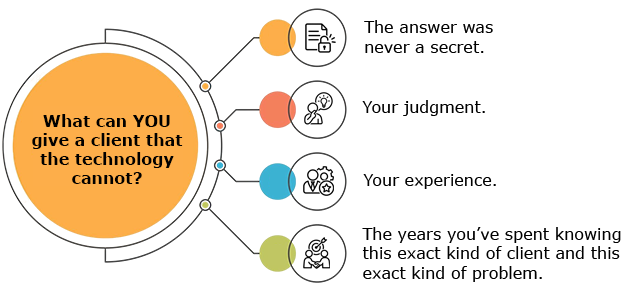
The report ends on a question every firm is going to have to answer. Sooner rather than later.
The ones who need attention blur into the ones who are fine. And the drift happens in that blur.
That’s the part no AI model can copy. And it gets stronger the moment you say it out loud.
So go first. Get to the conversation before your client gets there before you.
Done well, it does the opposite of what you’re afraid of. It tells the client you’re thinking about their work more carefully than the firm down the street that’s saying nothing at all.
I made the whole thing easy for you. The guide walks through the opening line, the three things to cover, and what to say when a client seems worried. One page. No form to fill.